Tuesday, September 27, 2016

Where Were You When You Purchased Your First Home?

A quick tour of the Mortgage Market from the 1970" to Present!  What was your first experience?

It’s not “if” the rate goes up but “when” the rate goes up; it could make a big difference for some buyers. Freddie Mac predicts that mortgage rates will be at 4.5% a year from now.Mortgage Rate History0916.png
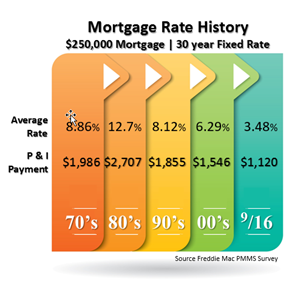
If buyers can afford a home with higher interest rates, it means higher payments. Higher payments might mean they won’t have the money to spend on other things like furniture or improvements to the home or an unrelated purchase like a new car.
When the rate moves 0.50% on a $250,000 mortgage, the payment goes up by $70.66 a month. If it moves 1.00%, the payment goes up by $143.74 per month, each and every month for the entire term of the mortgage which means paying over $50,000 more for the house.
The question facing every borrower in this situation is “How will you feel about having to pay more to live in the same house because you were not ready to commit?”
Then, there’s the borrower who is absolutely maxed out as to what they can qualify for or sometimes, it is a borrower who just refuses to pay a higher payment. When that’s the case, the buyer has to make a larger down payment. In the same example, a 0.50% increase in rate would require $14,873 more in down payment. That could make the purchase impossible or require the buyer to buy a lesser price home that will not have the same amenities.
Mortgage rates have been low for so long that some people think that is what they should be. There are some economists who believe that the economy will not be strong again until mortgage rates are in the 7% range.
To see how this type of scenario might affect you, go to the If the Rate Goes Up calculator.

Friday, September 23, 2016

When To Visit A House Of Interest.

What is the best time to visit a house that you are interested in?  This chart may be of interest to you in making a decision.


Monday, September 19, 2016

How is the Housing Market in your Area?

Here is an insight into the Housing Market in Your Area.  If you are looking to Purchase or Build.

http://eyeonhousing.org/2016/09/sale-and-contract-prices-per-square-foot-in-2015/


SOC_sqftprice15

Monday, September 12, 2016

Getting ready to be inside for the Winter..

With the doors open during the Spring, Summer and Fall, I have noticed a collection of dust around the house, I am sure that I am not alone.

Having a dust-free home isn’t difficult, but it takes a serious commitment and a housekeeping strategy that addresses the dust and its causes. Whether your motive is cleanliness or to eliminate the cause of some allergies and asthma symptoms, it will be worth it.10043513-250.jpg
  • Try to dust your home at least twice a week. Dust the tallest items and work your way down. Dust picture frames, blinds, baseboards and anything that stands out from the wall.
  • Feather dusters can spread more dust than they collect compared to microfiber cloths that attracts dust because they have an electrostatic charge.
  • Filters on heating and air-conditioning systems should be changed often not only to remove dust from the air but to increase the efficiency of the units themselves. Special HEPA filters can improve the overall indoor air quality.
  • Frequently changing the bag or emptying the container in your vacuum is helpful in eliminating dust.
  • Vacuum the floors at least once a week. Vacuum under furniture and periodically, move appliances to clean behind and underneath. Use the proper attachments to vacuum upholstered furniture and under cushions.
  • Eliminate dust magnets like carpet, heavy drapes and upholstered furniture. Consider hard surface flooring like wood or tile instead of carpet.
  • Keep windows closed to keep dust out.
  • Clean your pillows and drapes.
  • Damp mopping and dusting with plain water helps hold the dust and is environmentally friendly.
  • A humidifier can eliminate static electricity which holds dust.
  • Air purifiers circulate are and capture dust and other pollutants.

Wednesday, September 7, 2016

To Invest or Not To Invest.

Rental Property, is this for me?


contributing factors.png
Rental properties have five primary factors that contribute to the return on investment.  Based on market conditions and investor strategies, the individual motivating factor can change from property to property.
There was a time when the benefit of tax savings to offset income from other sources was considered important to some investors.  However, in today's environment, they are more likely valued as incidental benefits.
Some investors expect appreciation to deliver the satisfactory results which can be reasonable over time if a reliable appreciation rate is used.  Savvy investors today are using conservative estimates for long-term holding periods.
Leverage occurs when borrowed funds are used to control a larger asset.  Positive leverage can actually increase the yield on an investment.  Equity build-up happens due to the amortization of the loan which requires that a portion of the monthly payment reduces the principal owed.
The last component that contributes to a property's yield is the cash flow.  When the rents are greater than the expenses of operating the property and servicing the debt, there is a positive cash flow.  A property with a good cash flow doesn't have to go up in value to justify the investment.
The combination of lower prices, low mortgage rates and rising rents are attracting investors to rental properties that include single-family homes in predominantly owner-occupied neighborhoods.
Even if you were to ignore the benefits of tax savings, potential appreciation and leverage, the attractive cash flows make rental property a very smart investment alternative.  Contact me for more information

Wednesday, August 31, 2016

An Investment Route to Saving.

Helping your Children/ Grandchildren to Achieve Their College Goals.


kids to college.png
Most people have lots of reasons to save but not always enough discretionary income after the family essentials have been met.
A relatively small investment in a rental home can control a good home that will rent easily, generate positive cash flows and pay for itself.  The borrowed funds create leverage that earns a return on the total value of the home and not just the amount of cash you have invested.
The strategy is simple.  Find a slightly below average priced home that will rent well.  It will appeal to a larger group of people while it's rented and when it's ready to be sold.
Rent the home and maintain its condition over the years.  As the loan amortizes and the value increases, the equity will grow.  When your student is ready to start college, you'll actually have several options.
You can sell the property; pay the tax on the gain at the reduced capital gains rate and fund the education.  Another option would be to refinance and take the proceeds to pay for the tuition.  This would allow you to continue to own the asset but would free your equity and under current tax laws is a non-taxable event.
Regardless of whether you're trying to plan for your children's education or your own retirement, rental property offers many solid investment opportunities.  All investments contain risk.  Knowledge and expert advice from tax professionals can reduce the risk.  Contact me if you want more information.

Monday, August 29, 2016

How to Pay Off Your Mortgage.

Here are some great tips on paying off your Mortgage early.  


Pay Off Your Mortgage?

Becoming debt free is as much a part of the American Dream as owning a home but there certainly can be conflicting circumstances that make the decision to pay off your mortgage early unclear.
32498400-250.jpg
The advantages of paying off debt early is increased cash flow, less interest paid and a higher credit score. The disadvantages are lower cash flow available as discretionary funds for meals, entertainment and other things. If the ultimate goal is financial security, is it worth the intermediate sacrifice?
Whether you pay off your mortgage early is a personal decision that may be right for one person and not for another. Consider the following before you get started:
Reasons you should
  • Peace of mind knowing that you don’t have a mortgage
  • You’ll save interest regardless of how low your mortgage rate is
  • Lowering your housing costs before you retire
Reasons you shouldn’t
  • You can invest at a higher rate than your mortgage
  • You have other debt at a higher rate than your mortgage that needs to be paid off
  • You might need the money in the future and want to remain liquid
  • You might not qualify for a mortgage currently
  • You should pay off other debt with higher interest rates
  • Your employer has a matching retirement plan that would benefit you more
  • You have more urgent financial needs like emergency fund, life, health and disability insurance
  • You expect high inflation and the value of your mortgage debt will decrease
Use this Mortgage Accelerator to determine how quick you can pay off your mortgage.